SOX8/9/17/18 Antibody - #DF8720
 (2)
(3)
(2)
(3)

| Product: | SOX8/9/17/18 Antibody |
| Catalog: | DF8720 |
| Description: | Rabbit polyclonal antibody to SOX8/9/17/18 |
| Application: | WB IHC IF/ICC |
| Cited expt.: | WB, IHC |
| Reactivity: | Human, Mouse, Rat |
| Prediction: | Pig, Bovine, Horse, Sheep, Dog, Chicken, Xenopus |
| Mol.Wt.: | 47 kDa; 47kD,56kD,44kD,41kD(Calculated). |
| Uniprot: | P57073 | P48436 | Q9H6I2 | P35713 |
| RRID: | AB_2841924 |
Product Info
*The optimal dilutions should be determined by the end user. For optimal experimental results, antibody reuse is not recommended.
*Tips:
WB: For western blot detection of denatured protein samples. IHC: For immunohistochemical detection of paraffin sections (IHC-p) or frozen sections (IHC-f) of tissue samples. IF/ICC: For immunofluorescence detection of cell samples. ELISA(peptide): For ELISA detection of antigenic peptide.
Cite Format: Affinity Biosciences Cat# DF8720, RRID:AB_2841924.
Fold/Unfold
MGC24837; SOX 8; Sox8; SOX8_HUMAN; SRY (sex determining region Y) box 8; SRY box 8; SRY box containing gene 8; Transcription factor SOX 8; Transcription factor SOX-8; Transcription factor SOX8; campomelic dysplasia autosomal sex reversal; CMD 1; CMD1; CMPD 1; CMPD1; SOX 9; Sox9; SOX9_HUMAN; SRA 1; SRA1; SRXX2; SRXY10; SRY (sex determining region Y) box 9 (campomelic dysplasia autosomal; SRY (sex determining region Y) box 9; SRY (sex determining region Y)-box 9; SRY (sex-determining region Y)-box 9 protein; SRY related HMG box gene 9; Transcription factor SOX 9; Transcription factor SOX-9; transcription factor SOX9; FLJ22252; SOX17; SOX17_HUMAN; SRY (sex determining region Y) box 17; SRY box 17; SRY related HMG box transcription factor SOX17; Transcription factor SOX-17; Transcription factor SOX17; VUR3; HLTS; SOX 18; Sox18; SOX18_HUMAN; SRY (sex determining region Y) box 18; SRY box 18; Transcription factor SOX 18; Transcription factor SOX-18;
Immunogens
A synthesized peptide derived from human SOX8/9/17/18, corresponding to a region within the internal amino acids.
P57073(SOX8_HUMAN) >>Visit HPA database.
P48436(SOX9_HUMAN) >>Visit HPA database.
Expressed in adult heart, lung, spleen, testis, ovary, placenta, fetal lung, and kidney. In normal gastrointestinal tract, it is preferentially expressed in esophagus, stomach and small intestine than in colon and rectum.
P35713 SOX18_HUMAN:Detected in heart, lung, placenta, skeletal muscle, liver, kidney, spleen, prostate, ovary, msosmall intestine and colon.
- P57073 SOX8_HUMAN:
- Protein BLAST With
- NCBI/
- ExPASy/
- Uniprot
MLDMSEARSQPPCSPSGTASSMSHVEDSDSDAPPSPAGSEGLGRAGVAVGGARGDPAEAADERFPACIRDAVSQVLKGYDWSLVPMPVRGGGGGALKAKPHVKRPMNAFMVWAQAARRKLADQYPHLHNAELSKTLGKLWRLLSESEKRPFVEEAERLRVQHKKDHPDYKYQPRRRKSAKAGHSDSDSGAELGPHPGGGAVYKAEAGLGDGHHHGDHTGQTHGPPTPPTTPKTELQQAGAKPELKLEGRRPVDSGRQNIDFSNVDISELSSEVMGTMDAFDVHEFDQYLPLGGPAPPEPGQAYGGAYFHAGASPVWAHKSAPSASASPTETGPPRPHIKTEQPSPGHYGDQPRGSPDYGSCSGQSSATPAAPAGPFAGSQGDYGDLQASSYYGAYPGYAPGLYQYPCFHSPRRPYASPLLNGLALPPAHSPTSHWDQPVYTTLTRP
- P48436 SOX9_HUMAN:
- Protein BLAST With
- NCBI/
- ExPASy/
- Uniprot
MNLLDPFMKMTDEQEKGLSGAPSPTMSEDSAGSPCPSGSGSDTENTRPQENTFPKGEPDLKKESEEDKFPVCIREAVSQVLKGYDWTLVPMPVRVNGSSKNKPHVKRPMNAFMVWAQAARRKLADQYPHLHNAELSKTLGKLWRLLNESEKRPFVEEAERLRVQHKKDHPDYKYQPRRRKSVKNGQAEAEEATEQTHISPNAIFKALQADSPHSSSGMSEVHSPGEHSGQSQGPPTPPTTPKTDVQPGKADLKREGRPLPEGGRQPPIDFRDVDIGELSSDVISNIETFDVNEFDQYLPPNGHPGVPATHGQVTYTGSYGISSTAATPASAGHVWMSKQQAPPPPPQQPPQAPPAPQAPPQPQAAPPQQPAAPPQQPQAHTLTTLSSEPGQSQRTHIKTEQLSPSHYSEQQQHSPQQIAYSPFNLPHYSPSYPPITRSQYDYTDHQNSSSYYSHAAGQGTGLYSTFTYMNPAQRPMYTPIADTSGVPSIPQTHSPQHWEQPVYTQLTRP
- Q9H6I2 SOX17_HUMAN:
- Protein BLAST With
- NCBI/
- ExPASy/
- Uniprot
MSSPDAGYASDDQSQTQSALPAVMAGLGPCPWAESLSPIGDMKVKGEAPANSGAPAGAAGRAKGESRIRRPMNAFMVWAKDERKRLAQQNPDLHNAELSKMLGKSWKALTLAEKRPFVEEAERLRVQHMQDHPNYKYRPRRRKQVKRLKRVEGGFLHGLAEPQAAALGPEGGRVAMDGLGLQFPEQGFPAGPPLLPPHMGGHYRDCQSLGAPPLDGYPLPTPDTSPLDGVDPDPAFFAAPMPGDCPAAGTYSYAQVSDYAGPPEPPAGPMHPRLGPEPAGPSIPGLLAPPSALHVYYGAMGSPGAGGGRGFQMQPQHQHQHQHQHHPPGPGQPSPPPEALPCRDGTDPSQPAELLGEVDRTEFEQYLHFVCKPEMGLPYQGHDSGVNLPDSHGAISSVVSDASSAVYYCNYPDV
- P35713 SOX18_HUMAN:
- Protein BLAST With
- NCBI/
- ExPASy/
- Uniprot
MQRSPPGYGAQDDPPARRDCAWAPGHGAAADTRGLAAGPAALAAPAAPASPPSPQRSPPRSPEPGRYGLSPAGRGERQAADESRIRRPMNAFMVWAKDERKRLAQQNPDLHNAVLSKMLGKAWKELNAAEKRPFVEEAERLRVQHLRDHPNYKYRPRRKKQARKARRLEPGLLLPGLAPPQPPPEPFPAASGSARAFRELPPLGAEFDGLGLPTPERSPLDGLEPGEAAFFPPPAAPEDCALRPFRAPYAPTELSRDPGGCYGAPLAEALRTAPPAAPLAGLYYGTLGTPGPYPGPLSPPPEAPPLESAEPLGPAADLWADVDLTEFDQYLNCSRTRPDAPGLPYHVALAKLGPRAMSCPEESSLISALSDASSAVYYSACISG
Predictions
Score>80(red) has high confidence and is suggested to be used for WB detection. *The prediction model is mainly based on the alignment of immunogen sequences, the results are for reference only, not as the basis of quality assurance.
High(score>80) Medium(80>score>50) Low(score<50) No confidence
Research Backgrounds
May play a role in central nervous system, limb and facial development. May be involved in male sex determination. Binds the consensus motif 5'-[AT][AT]CAA[AT]G-3' (By similarity).
Nucleus.
Transcriptional regulator that plays a role in chondrocytes differentiation and skeletal development. Binds to the COL2A1 promoter and activates COL2A1 expression, as part of a complex with ZNF219 (By similarity).
Ubiquitinated. Ubiquitination leads to proteasomal degradation and is negatively regulated by DDRGK1.
Nucleus.
Acts as transcription regulator that binds target promoter DNA and bends the DNA. Binds to the sequences 5'-AACAAT-'3 or 5'-AACAAAG-3'. Modulates transcriptional regulation via WNT3A. Inhibits Wnt signaling. Promotes degradation of activated CTNNB1. Plays a key role in the regulation of embryonic development. Required for normal development of the definitive gut endoderm. Required for normal looping of the embryonic heart tube. Plays an important role in embryonic and postnatal vascular development, including development of arteries. Plays an important role in postnatal angiogenesis, where it is functionally redundant with SOX18. Required for the generation and maintenance of fetal hematopoietic stem cells, and for fetal hematopoiesis. Probable transcriptional activator in the premeiotic germ cells.
Nucleus.
Expressed in adult heart, lung, spleen, testis, ovary, placenta, fetal lung, and kidney. In normal gastrointestinal tract, it is preferentially expressed in esophagus, stomach and small intestine than in colon and rectum.
Transcriptional activator that binds to the consensus sequence 5'-AACAAAG-3' in the promoter of target genes and plays an essential role in embryonic cardiovascular development and lymphangiogenesis. Activates transcription of PROX1 and other genes coding for lymphatic endothelial markers. Plays an essential role in triggering the differentiation of lymph vessels, but is not required for the maintenance of differentiated lymphatic endothelial cells. Plays an important role in postnatal angiogenesis, where it is functionally redundant with SOX17. Interaction with MEF2C enhances transcriptional activation. Besides, required for normal hair development.
Nucleus.
Detected in heart, lung, placenta, skeletal muscle, liver, kidney, spleen, prostate, ovary, msosmall intestine and colon.
Binds target DNA via the HMG box domain.
Research Fields
· Environmental Information Processing > Signal transduction > cAMP signaling pathway. (View pathway)
· Environmental Information Processing > Signal transduction > Wnt signaling pathway. (View pathway)
References
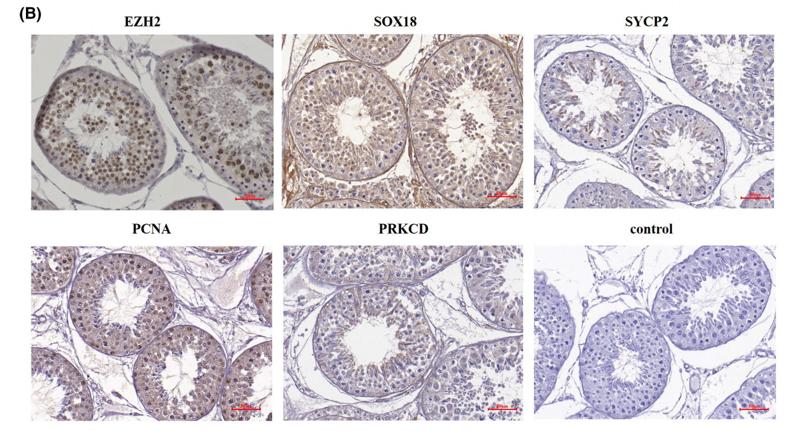
Application: IHC Species: sheep Sample: testicular cells

Application: WB Species: Hu Sheep Sample:
Restrictive clause
Affinity Biosciences tests all products strictly. Citations are provided as a resource for additional applications that have not been validated by Affinity Biosciences. Please choose the appropriate format for each application and consult Materials and Methods sections for additional details about the use of any product in these publications.
For Research Use Only.
Not for use in diagnostic or therapeutic procedures. Not for resale. Not for distribution without written consent. Affinity Biosciences will not be held responsible for patent infringement or other violations that may occur with the use of our products. Affinity Biosciences, Affinity Biosciences Logo and all other trademarks are the property of Affinity Biosciences LTD.