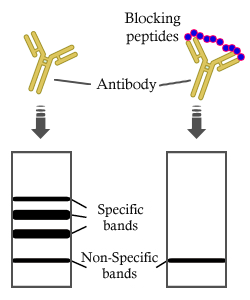
Product: Claudin 3 Antibody
Catalog: DF7115
Description: Rabbit polyclonal antibody to Claudin 3
Application: WB IHC IF/ICC
Cited expt.: WB
Reactivity: Human, Mouse, Rat
Prediction: Pig, Bovine, Sheep, Dog, Xenopus
Mol.Wt.: 23kDa; 23kD(Calculated).
Uniprot: O15551
RRID: AB_2839069

View similar products>>

   Size Price Inventory
 100ul $280 In stock
 200ul $350 In stock

Lead Time: Same day delivery

For pricing and ordering contact:
Local distributors

Product Info

Source:
Rabbit
Application:
WB 1:500-1:2000, IHC 1:50-1:100, IF/ICC 1:100-1:500
*The optimal dilutions should be determined by the end user. For optimal experimental results, antibody reuse is not recommended.
*Tips:

WB: For western blot detection of denatured protein samples. IHC: For immunohistochemical detection of paraffin sections (IHC-p) or frozen sections (IHC-f) of tissue samples. IF/ICC: For immunofluorescence detection of cell samples. ELISA(peptide): For ELISA detection of antigenic peptide.

Reactivity:
Human,Mouse,Rat
Prediction:
Pig(100%), Bovine(100%), Sheep(100%), Dog(100%), Xenopus(83%)
Clonality:
Polyclonal
Specificity:
Claudin 3 Antibody detects endogenous levels of total Claudin 3.
RRID:
AB_2839069
Cite Format: Affinity Biosciences Cat# DF7115, RRID:AB_2839069.
Conjugate:
Unconjugated.
Purification:
The antiserum was purified by peptide affinity chromatography using SulfoLink™ Coupling Resin (Thermo Fisher Scientific).
Storage:
Rabbit IgG in phosphate buffered saline , pH 7.4, 150mM NaCl, 0.02% sodium azide and 50% glycerol. Store at -20 °C. Stable for 12 months from date of receipt.
Alias:

Fold/Unfold

C7orf1; Claudin-3; Claudin3; CLD3_HUMAN; CLDN 3; Cldn3; Clostridium perfringens enterotoxin receptor 2; CPE R2; CPE receptor 2; CPE-R 2; CPE-receptor 2; CPETR 2; CPETR2; HRVP 1; HRVP1; Rat ventral prostate 1 like protein; Rat ventral prostate.1 protein homolog; RVP1; Ventral prostate.1 like protein; Ventral prostate.1 protein homolog;

Immunogens

Immunogen:

A synthesized peptide derived from human Claudin 3, corresponding to a region within C-terminal amino acids.

Uniprot:
Gene(ID):
Description:
Tight junctions represent one mode of cell-to-cell adhesion in epithelial or endothelial cell sheets, forming continuous seals around cells and serving as a physical barrier to prevent solutes and water from passing freely through the paracellular space. These junctions are comprised of sets of continuous networking strands in the outwardly facing cytoplasmic leaflet, with complementary grooves in the inwardly facing extracytoplasmic leaflet. The protein encoded by this intronless gene, a member of the claudin family, is an integral membrane protein and a component of tight junction strands. It is also a low-affinity receptor for Clostridium perfringens enterotoxin, and shares aa sequence similarity with a putative apoptosis-related protein found in rat.
Sequence:
MSMGLEITGTALAVLGWLGTIVCCALPMWRVSAFIGSNIITSQNIWEGLWMNCVVQSTGQMQCKVYDSLLALPQDLQAARALIVVAILLAAFGLLVALVGAQCTNCVQDDTAKAKITIVAGVLFLLAALLTLVPVSWSANTIIRDFYNPVVPEAQKREMGAGLYVGWAAAALQLLGGALLCCSCPPREKKYTATKVVYSAPRSTGPGASLGTGYDRKDYV

Predictions

Predictions:

Score>80(red) has high confidence and is suggested to be used for WB detection. *The prediction model is mainly based on the alignment of immunogen sequences, the results are for reference only, not as the basis of quality assurance.

Species
Results
Score
Pig
100
Bovine
100
Sheep
100
Dog
100
Xenopus
83
Horse
0
Zebrafish
0
Chicken
0
Rabbit
0
Model Confidence:
High(score>80) Medium(80>score>50) Low(score<50) No confidence

Research Backgrounds

Function:

Plays a major role in tight junction-specific obliteration of the intercellular space, through calcium-independent cell-adhesion activity.

Subcellular Location:

Cell junction>Tight junction. Cell membrane>Multi-pass membrane protein.

Extracellular region or secreted Cytosol Plasma membrane Cytoskeleton Lysosome Endosome Peroxisome ER Golgi apparatus Nucleus Mitochondrion Manual annotation Automatic computational assertionSubcellular location
Family&Domains:

Belongs to the claudin family.

Research Fields

· Cellular Processes > Cellular community - eukaryotes > Tight junction.   (View pathway)

· Environmental Information Processing > Signaling molecules and interaction > Cell adhesion molecules (CAMs).   (View pathway)

· Human Diseases > Infectious diseases: Viral > Hepatitis C.

· Organismal Systems > Immune system > Leukocyte transendothelial migration.   (View pathway)

References

1). Polystyrene micro-and nano-particle coexposure injures fetal thalamus by inducing ROS-mediated cell apoptosis. ENVIRONMENT INTERNATIONAL, 2022 (PubMed: 35749991) [IF=10.3]

Application: WB    Species: Human    Sample: JEG-3 cells

Fig. 7. Biological effects of PS particles on the placenta and JEG-3 cells. (A) Representative images of H&E of placenta from indicated mice. scale bar = 2 mm. (B) The ratio of junction zone to the total placental area is shown. (C) Representative merged fluorescence images of cleaved caspase-3 in the placenta; scale bar = 100 μm. (D) The mean cleaved caspase-3 fluorescence intensity in the labyrinth zone of placenta is shown. (E) Representative merged fluorescence images of TUNEL in the labyrinth zone of placenta; scale bar = 100 μm. (F) The ratio of TUNEL-positive cells in the labyrinth zone of placenta is shown. (G) Representative merged fluorescence images of the fetal endothelium of placenta stained with cleaved CLDN3; scale bar = 100 μm. (H) Quantification of the mean CLDN3 fluorescence intensity in the fetal endothelium of placenta is shown. (I) TEM images of the gap between two cells in the fetal endothelium of placenta. White arrowhead represents the dilated gap, scale bar = 0.5 μm. (J) The total antioxidant capacity in the placenta is shown. (K) JEG-3 cells were exposed to PS particles at various doses for 24 h or 48 h, and cell viability was determined using the CCK-8 method. (L) Internalization of PS particles in JEG-3 cells was observed by confocal fluorescence microscopy. (M) Quantification of the mean PS particle fluorescence intensity in JEG-3 cells is shown. (N) JEG-3 cells were collected to measure DNA synthesis using an EdU proliferation assay; scale bar = 400 μm. (O) The ratio of EdU-positive JEG-3 cells is shown. (P) The cell cycle distributions of JEG-3 cells were measured using flow cytometry. (Q) JEG-3 cells were incubated with DCFH-DA for 20 min, and ROS levels were observed when JEG-3 cells were exposed to PS particles for 48 h; scale bar = 400 μm. (R) The quantification of the mean DCFH-DA fluorescence intensity in JEG-3 cells is shown. (S) JEG-3 cells were stained with annexin V-FITC/PI and analyzed by flow cytometry. (T) The protein expression of cleaved caspase-3 and BCL2 was measured by Western blotting and analyzed in JEG-3 cells. (U) Representative merged fluorescence images of JEG-3 cells stained with CLDN3; scale bar = 100 μm. (V) The protein expression of CLDN3 was measured by Western blotting and analyzed in JEG-3 cells. The data are presented as the means ± SD (*p < 0.05; **p < 0.01). In A, dashed lines delineate the decidua zone (D), junction zone (J) and labyrinth layer (L). In G, dashed lines delineate the fetal vessel endothelium.

Restrictive clause


Affinity Biosciences tests all products strictly. Citations are provided as a resource for additional applications that have not been validated by Affinity Biosciences. Please choose the appropriate format for each application and consult Materials and Methods sections for additional details about the use of any product in these publications.

For Research Use Only.
Not for use in diagnostic or therapeutic procedures. Not for resale. Not for distribution without written consent. Affinity Biosciences will not be held responsible for patent infringement or other violations that may occur with the use of our products. Affinity Biosciences, Affinity Biosciences Logo and all other trademarks are the property of Affinity Biosciences LTD.