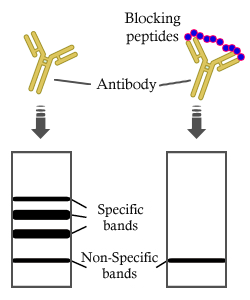
Product: Cleaved-DFNA5/GSDME Antibody - N-terminal
Catalog: AF4016
Description: Rabbit polyclonal antibody to Cleaved-DFNA5/GSDME - N-terminal
Application: WB
Cited expt.: WB
Reactivity: Human, Mouse
Mol.Wt.: 30kDa; 55kD(Calculated).
Uniprot: O60443

View similar products>>

   Size Price Inventory
 100ul $280 In stock
 200ul $350 In stock

Lead Time: Same day delivery

For pricing and ordering contact:
Local distributors

Product Info

Source:
Rabbit IgG
Application:
WB 1:500-1:2000
*The optimal dilutions should be determined by the end user. For optimal experimental results, antibody reuse is not recommended.
*Tips:

WB: For western blot detection of denatured protein samples. IHC: For immunohistochemical detection of paraffin sections (IHC-p) or frozen sections (IHC-f) of tissue samples. IF/ICC: For immunofluorescence detection of cell samples. ELISA(peptide): For ELISA detection of antigenic peptide.

Reactivity:
Human,Mouse
Clonality:
Polyclonal
Specificity:
DFNA5/GSDME Antibody detects N-terminal fragment of DFNA5/GSDME.
Conjugate:
Unconjugated.
Purification:
The antiserum was purified by peptide affinity chromatography using SulfoLink™ Coupling Resin (Thermo Fisher Scientific).
Storage:
Rabbit IgG in phosphate buffered saline , pH 7.4, 150mM NaCl, 0.02% sodium azide and 50% glycerol. Store at -20 °C. Stable for 12 months from date of receipt.
Alias:

Fold/Unfold

2310037D07Rik; 4932441K13Rik; Deafness, autosomal dominant 5; Deafness, autosomal dominant 5 protein; DFNA5; DFNA5 gene; DFNA5_HUMAN; Dfna5h; EG14210; Fin15; ICERE 1; ICERE-1; Inversely correlated with estrogen receptor expression 1; Non-syndromic hearing impairment protein 5; Nonsyndromic hearing impairment protein; Gasdermin-E;GSDME_HUMAN;ICERE1;

Immunogens

Immunogen:

A synthesized peptide derived from human DFNA5(Accession O60443), corresponding to N-terminal amino acid.

Uniprot:
Gene(ID):
Expression:
O60443 GSDME_HUMAN:

Expressed in cochlea. Low level of expression in heart, brain, placenta, lung, liver, skeletal muscle, kidney and pancreas, with highest expression in placenta.

Sequence:
MFAKATRNFLREVDADGDLIAVSNLNDSDKLQLLSLVTKKKRFWCWQRPKYQFLSLTLGDVLIEDQFPSPVVVESDFVKYEGKFANHVSGTLETALGKVKLNLGGSSRVESQSSFGTLRKQEVDLQQLIRDSAERTINLRNPVLQQVLEGRNEVLCVLTQKITTMQKCVISEHMQVEEKCGGIVGIQTKTVQVSATEDGNVTKDSNVVLEIPAATTIAYGVIELYVKLDGQFEFCLLRGKQGGFENKKRIDSVYLDPLVFREFAFIDMPDAAHGISSQDGPLSVLKQATLLLERNFHPFAELPEPQQTALSDIFQAVLFDDELLMVLEPVCDDLVSGLSPTVAVLGELKPRQQQDLVAFLQLVGCSLQGGCPGPEDAGSKQLFMTAYFLVSALAEMPDSAAALLGTCCKLQIIPTLCHLLRALSDDGVSDLEDPTLTPLKDTERFGIVQRLFASADISLERLKSSVKAVILKDSKVFPLLLCITLNGLCALGREHS

Research Backgrounds

Function:

Plays a role in the TP53-regulated cellular response to DNA damage probably by cooperating with TP53.

Switches CASP3-mediated apoptosis induced by TNF or danger signals, such as chemotherapy drugs, to pyroptosis. Produced by the cleavage of GSDME by CASP3, perforates cell membrane and thereby induces pyroptosis. After cleavage, moves to the plasma membrane where it strongly binds to inner leaflet lipids, bisphosphorylated phosphatidylinositols, such as phosphatidylinositol (4,5)-bisphosphate. Mediates secondary necrosis downstream of the mitochondrial apoptotic pathway and CASP3 activation as well as in response to viral agents. Exhibits bactericidal activity.

PTMs:

Cleavage at Asp-270 by CASP3 (mature and uncleaved precursor forms) relieves autoinhibition and is sufficient to initiate pyroptosis.

Subcellular Location:

Cell membrane.

Cytoplasm>Cytosol.

Extracellular region or secreted Cytosol Plasma membrane Cytoskeleton Lysosome Endosome Peroxisome ER Golgi apparatus Nucleus Mitochondrion Manual annotation Automatic computational assertionSubcellular location
Tissue Specificity:

Expressed in cochlea. Low level of expression in heart, brain, placenta, lung, liver, skeletal muscle, kidney and pancreas, with highest expression in placenta.

Family&Domains:

Intramolecular interactions between N- and C-terminal domains may be important for autoinhibition in the absence of activation signal. The intrinsic pyroptosis-inducing activity is carried by the N-terminal domain, that is released upon cleavage by CASP3.

Belongs to the gasdermin family.

References

1). PLGA confers upon conventional nonfluorescent molecules luminescent properties to trigger 1O2-induced pyroptosis and immune response in tumors. Journal of nanobiotechnology, 2025 (PubMed: 39844156) [IF=10.2]

Application: WB    Species: Mouse    Sample: CT26 cells

Fig. 6 (A-D) Intracellular ROS levels were measured by CLSM stained with DCFH-DA and analyzed by FCM. Scale bars: 100 μm. (E) ROS images and pyroptotic morphological changes were captured by CLSM. Vitamin C (Vc) and vitamin K3 (Vk3) were used as a 1O2 scavenger and 1O2 inducer, respectively; scale bar: 40 μm. The yellow arrows represent the pyroptotic bodies. (F) Intracellular ROS levels were measured by FCS after pretreatment with Vc or Vk3. (G) Cleavage of GSDME and caspase-3 from CT26 cells following 8-hour treatment of CUR@PLGA-NPs + Light at a concentration of 10 µM as detected by western blot analysis. (H) CLSM images showing GSDME-N expression after being treated with Control, CuET, Cisplatin, NPs + Light, CuET + NPs + Light, and Cisplatin + NPs + Light. (I) LDH release analysis showing influence of CuET and Cisplatin on NPs + Light-induced pyroptosis. (J) Schematic illustration of the proposed pyroptosis activation via 1O2 generation

Application: IF/ICC    Species: Mouse    Sample: CT26 cells
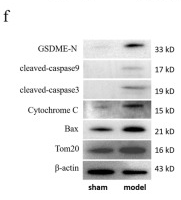
Fig. 6 (A-D) Intracellular ROS levels were measured by CLSM stained with DCFH-DA and analyzed by FCM. Scale bars: 100 μm. (E) ROS images and pyroptotic morphological changes were captured by CLSM. Vitamin C (Vc) and vitamin K3 (Vk3) were used as a 1O2 scavenger and 1O2 inducer, respectively; scale bar: 40 μm. The yellow arrows represent the pyroptotic bodies. (F) Intracellular ROS levels were measured by FCS after pretreatment with Vc or Vk3. (G) Cleavage of GSDME and caspase-3 from CT26 cells following 8-hour treatment of CUR@PLGA-NPs + Light at a concentration of 10 µM as detected by western blot analysis. (H) CLSM images showing GSDME-N expression after being treated with Control, CuET, Cisplatin, NPs + Light, CuET + NPs + Light, and Cisplatin + NPs + Light. (I) LDH release analysis showing influence of CuET and Cisplatin on NPs + Light-induced pyroptosis. (J) Schematic illustration of the proposed pyroptosis activation via 1O2 generation

2). Iron induces B cell pyroptosis through Tom20–Bax–caspase–gasdermin E signaling to promote inflammation post-spinal cord injury. Journal of Neuroinflammation, 2023 (PubMed: 37480037) [IF=9.3]

Application: WB    Species: Mouse    Sample: B cells

Fig. 3 Pyroptosis induced by iron accumulation may occur in splenic B cells after SCI. a Three days after SCI, serum samples were collected for quantification of the protein expression levels of MCP-1, IL-1β, IL-6, and TNF-α by ELISA. b Three days after SCI, injured spinal cord homogenates were collected for quantification of the protein expression levels of MCP-1, IL-1β, IL-6, and TNF-α by ELISA. c Three days after SCI, the spleen was stained with Prussian blue to detect the level of iron ion. d Three days after SCI, serum samples were collected to quantify the concentration of iron ions. e Three days after SCI, B cell lysates were collected to quantify the concentration of iron ions. f Detection of Tom20-Bax-caspase-GSDME pathway-related protein expression in B cells by western blot. g The knock-down efficiency of AAV on Tom20 in B cells was verified. h, l, m The expression levels of MCP-1, IL-1 β, IL-6, TNF- α, IgG and IgM in serum of different groups were detected by ELISA. i–k Three days after SCI, the spleens of mice were observed, and the spleen length and organ index of different groups were compared. n, o, q The spleen was taken for HE staining, Prussian blue staining, and immunofluorescence. CD19+ was red, dapi was blue, and merge was combined. p Detection of nerve evoked potentials in different groups of mice. r Detection of the expression of Tom20-Bax-caspsae-GSDME pathway-related proteins in different groups of B cells. All data are expressed as the mean ± SD (n ≥ 3 replicates per group). ns P > 0.05, * P 

3). Neuronal-specific TNFAIP1 ablation attenuates postoperative cognitive dysfunction via targeting SNAP25 for K48-linked ubiquitination. Cell communication and signaling : CCS, 2023 (PubMed: 38102610) [IF=8.4]

4). A nanoplatform integrating sonodynamic and manganese to enhance tumor immunotherapy via synergistic activation of the cGAS-STING pathway. Materials & Design, 2025 [IF=7.9]

Application: WB    Species: Mouse    Sample: 4T1 cells

Fig. 5. Induction of pyroptosis, activation of the cGAS-STING pathway, and promotion of DC maturation by PNCM. (a) Western blots of GSDME-FL, GSDME-N, and Cleaved caspase-3 expression in 4T1 cells after different treatments.

5). Curcumin enhances GSDME-mediated pyroptosis to potentiate PD-1/PD-L1 immune checkpoint blockade in colorectal cancer. Frontiers in pharmacology, 2026 (PubMed: 41704275) [IF=5.6]

Application: IHC    Species: human    Sample:

FIGURE 1. (A) General information of the CRC patients and their tumor specimens included in the study. (B) Patients were divided into high- and low-expression groups using an IHC score cutoff of 1.7. (C) Representative IHC images of the high- and low-expression groups. (D) Association between GSDME expression and overall survival of patients. (E) Correlation of GSDME expression with intratumoral CD8+ T-cell infiltration and PD-L1 expression.

6). Mechanistic Study of cGAS-STING Pathway–Induced Pyroptosis in Corneal Epithelial Cells in Keratoconjunctivitis Sicca. Pakistan Veterinary Journal, 2026 [IF=5.4]

Application: WB    Species: Mouse    Sample: corneal tissues

Fig. 2: H151 reduces corneal epithelial pyroptosis in DED mice by inhibiting the cGAS-STING pathway. (A) TUNEL staining (400×25μm). (B-D) WB analysis of pyroptosis-related protein expression in corneal tissues. (E) qRT-PCR analysis of pyroptosis-related mRNA levels in corneal tissues. n=6; *P

7). ETV5 transcriptionally inhibits KIF23 to repress pyroptosis in aged mice with perioperative neurocognitive disorders. Biochemical pharmacology, 2025 (PubMed: 40983152) [IF=5.3]

8). Neuroprotection of celastrol against postoperative cognitive dysfunction through dampening cGAS-STING signaling. Experimental neurology, 2024 (PubMed: 39369806) [IF=4.6]

9). KIF23 inhibition protects against perioperative neurocognitive disorders by hindering ROS/caspase-3/GSDME-mediated pyroptosis. Experimental neurology, 2025 (PubMed: 40639436) [IF=4.6]

10). Pharmacological suppression of lactate mitigates postoperative cognitive dysfunction. Experimental neurology, 2026 (PubMed: 41238154) [IF=4.6]

Application: WB    Species: Mouse    Sample: hippocampus

Fig. 7. SNAP25 silencing abrogates the pro-mitophagic and anti-pyroptotic properties of OXA. (G) Western blot analysis of N-GSDME and SNAP25 protein levels in the hippocampus of mice following the indicated treatments.

Load more

Restrictive clause


Affinity Biosciences tests all products strictly. Citations are provided as a resource for additional applications that have not been validated by Affinity Biosciences. Please choose the appropriate format for each application and consult Materials and Methods sections for additional details about the use of any product in these publications.

For Research Use Only.
Not for use in diagnostic or therapeutic procedures. Not for resale. Not for distribution without written consent. Affinity Biosciences will not be held responsible for patent infringement or other violations that may occur with the use of our products. Affinity Biosciences, Affinity Biosciences Logo and all other trademarks are the property of Affinity Biosciences LTD.