Product: NeuN Antibody
Catalog: DF6145
Description: Rabbit polyclonal antibody to NeuN
Application: WB IHC IF/ICC
Cited expt.: WB, IF/ICC
Reactivity: Human, Mouse, Rat
Prediction: Pig, Bovine, Horse, Sheep, Rabbit, Dog, Chicken
Mol.Wt.: 45-55kD; 34kD(Calculated).
Uniprot: A6NFN3
RRID: AB_2838112

View similar products>>

   Size Price Inventory
 100ul $280 In stock
 200ul $350 In stock

Lead Time: Same day delivery

For pricing and ordering contact:
Local distributors

Product Info

Source:
Rabbit
Application:
WB 1:500-1:2000, IHC 1:50-1:200, IF/ICC 1:100-1:500
*The optimal dilutions should be determined by the end user. For optimal experimental results, antibody reuse is not recommended.
*Tips:

WB: For western blot detection of denatured protein samples. IHC: For immunohistochemical detection of paraffin sections (IHC-p) or frozen sections (IHC-f) of tissue samples. IF/ICC: For immunofluorescence detection of cell samples. ELISA(peptide): For ELISA detection of antigenic peptide.

Reactivity:
Human,Mouse,Rat
Prediction:
Pig(100%), Bovine(100%), Horse(100%), Sheep(100%), Rabbit(100%), Dog(100%), Chicken(100%)
Clonality:
Polyclonal
Specificity:
NeuN Antibody detects endogenous levels of total NeuN.
RRID:
AB_2838112
Cite Format: Affinity Biosciences Cat# DF6145, RRID:AB_2838112.
Conjugate:
Unconjugated.
Purification:
The antiserum was purified by peptide affinity chromatography using SulfoLink™ Coupling Resin (Thermo Fisher Scientific).
Storage:
Rabbit IgG in phosphate buffered saline , pH 7.4, 150mM NaCl, 0.02% sodium azide and 50% glycerol. Store at -20 °C. Stable for 12 months from date of receipt.
Alias:

Fold/Unfold

FLJ56884; FLJ58356; Fox-1 homolog C; fox1 homolog C; Fox3; FOX3NeuN; hexaribonucleotide binding protein 3; HRNBP3; NEUN; neuronal nuclei; Rbfox3; RFOX3_HUMAN; RNA binding protein fox-1 homolog 3; RNA binding protein, fox 1 homolog (C. elegans) 3;

Immunogens

Immunogen:

A synthesized peptide derived from human NeuN, corresponding to a region within C-terminal amino acids.

Uniprot:
Gene(ID):
Description:
NeuN, also named as FOX3 and RBFOX3, is neuronal-specific nuclear protein with MW 38-50kd(~48kd). It is one of a family of 3 mammalian Fox homologues. FOX3(Or NeuN) functions in RNA-binding protein that regulates alternative splicing events.
Sequence:
MAQPYPPAQYPPPPQNGIPAEYAPPPPHPTQDYSGQTPVPTEHGMTLYTPAQTHPEQPGSEASTQPIAGTQTVPQTDEAAQTDSQPLHPSDPTEKQQPKRLHVSNIPFRFRDPDLRQMFGQFGKILDVEIIFNERGSKGFGFVTFETSSDADRAREKLNGTIVEGRKIEVNNATARVMTNKKTGNPYTNGWKLNPVVGAVYGPEFYAVTGFPYPTTGTAVAYRGAHLRGRGRAVYNTFRAAPPPPPIPTYGAVVYQDGFYGAEIYGGYAAYRYAQPAAAAAAYSDSYGRVYAAADPYHHTIGPAATYSIGTM

Predictions

Predictions:

Score>80(red) has high confidence and is suggested to be used for WB detection. *The prediction model is mainly based on the alignment of immunogen sequences, the results are for reference only, not as the basis of quality assurance.

Species
Results
Score
Pig
100
Horse
100
Bovine
100
Sheep
100
Dog
100
Chicken
100
Rabbit
100
Xenopus
0
Zebrafish
0
Model Confidence:
High(score>80) Medium(80>score>50) Low(score<50) No confidence

Research Backgrounds

Function:

Pre-mRNA alternative splicing regulator. Regulates alternative splicing of RBFOX2 to enhance the production of mRNA species that are targeted for nonsense-mediated decay (NMD).

Subcellular Location:

Nucleus. Cytoplasm.
Note: Largely restricted to neuronal nuclei. However, significant cytoplasmic localization in neurons from brains from HIV-infected individuals with cognitive impairment.

Extracellular region or secreted Cytosol Plasma membrane Cytoskeleton Lysosome Endosome Peroxisome ER Golgi apparatus Nucleus Mitochondrion Manual annotation Automatic computational assertionSubcellular location

References

1). miR-218a-5p derived from neural stem cell-exosomes inhibits ferroptosis in spinal cord injury through the Bmil/Mettl3/Alox12 axis. International journal of biological macromolecules, 2025 (PubMed: 41067360) [IF=7.7]

2). Sodium tanshinone IIA sulfonate promotes proliferation and differentiation of endogenous neural stem cells to repair rat spinal cord injury via the Notch pathway. Journal of translational medicine, 2025 (PubMed: 40128847) [IF=7.4]

Application: IF/ICC    Species: Rat    Sample:

Fig. 2 STS modulates the differentiation of spinal cord NSCs. (A-C) Immunofluorescence staining results for Nestin, GFAP, and NeuN. DAPI (blue), Nestin/GFAP/NeuN (green). Scale bar: 20 μm. (D-E) Comparison of the percentage of positive cells relative to DAPI-positive cells for GFAP and NeuN immunofluorescence staining. Data are expressed as the means ± S.D. (n = 3 per group). * represents P 

Application: WB    Species: Rat    Sample:

Fig. 2 STS modulates the differentiation of spinal cord NSCs. (A-C) Immunofluorescence staining results for Nestin, GFAP, and NeuN. DAPI (blue), Nestin/GFAP/NeuN (green). Scale bar: 20 μm. (D-E) Comparison of the percentage of positive cells relative to DAPI-positive cells for GFAP and NeuN immunofluorescence staining. Data are expressed as the means ± S.D. (n = 3 per group). * represents P 

3). Berberine Inhibits the Disruption of the Blood-Brain Barrier and Glial Cell Activation in a Rat Model of Acute Hepatic Encephalopathy. Phytotherapy research : PTR, 2025 (PubMed: 39791947) [IF=7.2]

4). The effect of tau K677 lactylation on ferritinophagy and ferroptosis in Alzheimer's disease. Free radical biology & medicine, 2024 (PubMed: 39307193) [IF=7.1]

5). Leptin promotes angiogenesis via pericyte STAT3 pathway upon intracerebral hemorrhage. Cells, 2022 (PubMed: 36078162) [IF=6.0]

6). Neuroprotective effects of rapamycin on spinal cord injury in rats by increasing autophagy and Akt signaling. Neural Regeneration Research, 2019 (PubMed: 30632514) [IF=5.9]

Application: IF/ICC    Species: rat    Sample: dorsal column
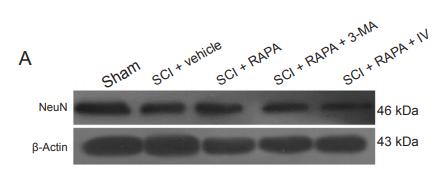
Figure 2 |Immunofluorescence staining of Beclin 1, NeuN and GFAP in the dorsal column along the epicenter at 24 hours after SCI (fluorescence microscope). Double staining of Beclin 1/NeuN and Beclin 1/GFAP were observed. Fluorescence colors: NeuN: green, GFAP: green and Beclin 1: red (n = 6). Scale bars: 100 μm. RAPA: Rapamycin; SCI: spinal cord injury, GFAP: glial fibrillary acidic protein.

Application: WB    Species: rat    Sample: dorsal column

Figure 9| NeuN expression in the dorsal column at 24 hours after SCI. (A) Representative western blots showing levels of NeuN. (B) Relative band densities of NeuN. The densities of the protein bands were analyzed and normalized to β-actin. Data are expressed as the mean ± SD (n = 6; one-way analysis of variance followed by Dunnett’s t-test). *P < 0.05, vs. sham group; #P < 0.05, vs. SCI + vehicle group; ?P < 0.05, vs. SCI + RAPA group. RAPA: Rapamycin; 3-MA: 3-methyladenine; IV: Akt inhibitor IV; SCI: spinal cord injury.

7). Erythropoietin inhibits ferroptosis and ameliorates neurological function after spinal cord injury. Neural Regeneration Research, 2023 (PubMed: 36204858) [IF=5.9]

Application: IF/ICC    Species: Rat    Sample: PC12 cells

Figure 5 EPO inhibits neuronal ferroptosis via upregulating expressions of xCT and Gpx4. (A) Double-labeled immunofluorescent staining of 4-Hne (red, TRITC)/NeuN (neuronal marker, green, FITC) from injured tissue and relative fluorescence intensity analysis at 14 dpi. (B) Double-labeled immunofluorescent staining of Gpx4 (red, TRITC)/NeuN (green, FITC) from injured tissue and relative fluorescence intensity analysis at 14 dpi. (C) Double-labeled immunofluorescent staining of xCT (red, TRITC)/NeuN (green, FITC) from injured tissue and relative fluorescence intensity analysis at 14 dpi. Nuclei were stained by DAPI (blue). Scale bars: 100 μm. All data are expressed as the mean ± SD (n = 5 in each group). *P < 0.05, **P < 0.01, ***P < 0.001 (one-way analysis of variance followed by Dunnett’s multiple comparisons test). 4-Hne: 4-Hydroxynonenal; Dapi: 2-(4-amidinophenyl)-6-indolecarbamidine dihydrochloride; dpi: day(s) post injury; EPO: erythropoietin; Fer-1: ferrostatin-1; FITC: fluorescein isothiocyanate; Gpx4: glutathione peroxidase 4; IF: immunofluorescent; NeuN: neuronal nuclei antigen; RSL3: (1S,3R)-RSL3; SCI: spinal cord injury; TRITC: tetramethylrhodamine isothiocyanate; xCT: the solute carrier family 7 member 11.

8). Total Flavones of Rhododendron Promotes Microglial Polarization to the M2 Subtype via Inhibiting the NOX2/ROS Pathway in Poststroke Mice with Depression-Like Behavior. Antioxidants & redox signaling, 2025 (PubMed: 40569016) [IF=5.9]

9). Decoding the Protective Mechanisms of Rosa roxburghii Fermented Juice against CUMS-Induced Depression-like Behaviors: Insights from Gut Microbiota and Neuroinflammation. Journal of agricultural and food chemistry, 2026 (PubMed: 41474946) [IF=5.7]

10). Promoting spinal cord injury repair by using ZnO@MOFs nanozymes functionalized hydrogel through the ROS microenvironment regulating pathway. Regenerative biomaterials, 2025 (PubMed: 41190134) [IF=5.6]

Application: IF/ICC    Species: Rat    Sample: PC12 cells

Figure 7.(A) Analysis of MDA, SOD and GSH in various groups. (B) TUNEL apoptosis results. (C) Fluorescence microscopy images of ZnO-ZIF8@H and ZnO-ZIF8@H+NIR treated spinal cord tissue sections, bar = 50 μm. (D) Quantification of TUNEL fluorescence intensity. (E) Cleaved-Caspase3’s quantification results.

Load more

Restrictive clause


Affinity Biosciences tests all products strictly. Citations are provided as a resource for additional applications that have not been validated by Affinity Biosciences. Please choose the appropriate format for each application and consult Materials and Methods sections for additional details about the use of any product in these publications.

For Research Use Only.
Not for use in diagnostic or therapeutic procedures. Not for resale. Not for distribution without written consent. Affinity Biosciences will not be held responsible for patent infringement or other violations that may occur with the use of our products. Affinity Biosciences, Affinity Biosciences Logo and all other trademarks are the property of Affinity Biosciences LTD.