Product: HSL Antibody
Catalog: AF6403
Description: Rabbit polyclonal antibody to HSL
Application: WB IHC IF/ICC
Cited expt.: WB
Reactivity: Human, Mouse, Rat
Prediction: Pig, Bovine, Horse, Sheep, Rabbit, Dog
Mol.Wt.: 85kDa; 117kD(Calculated).
Uniprot: Q05469
RRID: AB_2835234

View similar products>>

   Size Price Inventory
 100ul $280 In stock
 200ul $350 In stock

Lead Time: Same day delivery

For pricing and ordering contact:
Local distributors

Product Info

Source:
Rabbit
Application:
WB 1:500-1:2000, IHC 1:50-1:200, IF/ICC 1:100-1:500
*The optimal dilutions should be determined by the end user. For optimal experimental results, antibody reuse is not recommended.
*Tips:

WB: For western blot detection of denatured protein samples. IHC: For immunohistochemical detection of paraffin sections (IHC-p) or frozen sections (IHC-f) of tissue samples. IF/ICC: For immunofluorescence detection of cell samples. ELISA(peptide): For ELISA detection of antigenic peptide.

Reactivity:
Human,Mouse,Rat
Prediction:
Pig(100%), Bovine(100%), Horse(100%), Sheep(100%), Rabbit(91%), Dog(100%)
Clonality:
Polyclonal
Specificity:
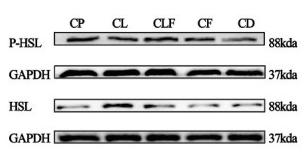
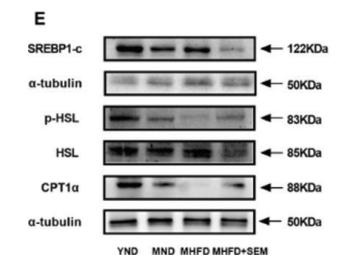
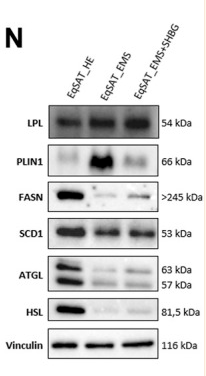
HSL Antibody detects endogenous levels of total HSL.
RRID:
AB_2835234
Cite Format: Affinity Biosciences Cat# AF6403, RRID:AB_2835234.
Conjugate:
Unconjugated.
Purification:
The antiserum was purified by peptide affinity chromatography using SulfoLink™ Coupling Resin (Thermo Fisher Scientific).
Storage:
Rabbit IgG in phosphate buffered saline , pH 7.4, 150mM NaCl, 0.02% sodium azide and 50% glycerol. Store at -20 °C. Stable for 12 months from date of receipt.
Alias:

Fold/Unfold

Hormone sensitive lipase; Hormone sensitive lipase testicular isoform; Hormone-sensitive lipase; HSL; LHS; Lipase hormone sensitive; LIPE; LIPS_HUMAN;

Immunogens

Immunogen:

A synthesized peptide derived from human HSL, corresponding to a region within the internal amino acids.

Uniprot:
Gene(ID):
Description:
hormone sensitive lipase is a lipolytic enzyme of the 'GDXG' family. Plays a rate limiting step in triglyceride lipolysis. In adipose tissue and heart, it primarily hydrolyzes stored triglycerides to free fatty acids, while in steroidogenic tissues, it principally converts cholesteryl esters to free cholesterol for steroid hormone production.
Sequence:
MEPGSKSVSRSDWQPEPHQRPITPLEPGPEKTPIAQPESKTLQGSNTQQKPASNQRPLTQQETPAQHDAESQKEPRAQQKSASQEEFLAPQKPAPQQSPYIQRVLLTQQEAASQQGPGLGKESITQQEPALRQRHVAQPGPGPGEPPPAQQEAESTPAAQAKPGAKREPSAPTESTSQETPEQSDKQTTPVQGAKSKQGSLTELGFLTKLQELSIQRSALEWKALSEWVTDSESESDVGSSSDTDSPATMGGMVAQGVKLGFKGKSGYKVMSGYSGTSPHEKTSARNHRHYQDTASRLIHNMDLRTMTQSLVTLAEDNIAFFSSQGPGETAQRLSGVFAGVREQALGLEPALGRLLGVAHLFDLDPETPANGYRSLVHTARCCLAHLLHKSRYVASNRRSIFFRTSHNLAELEAYLAALTQLRALVYYAQRLLVTNRPGVLFFEGDEGLTADFLREYVTLHKGCFYGRCLGFQFTPAIRPFLQTISIGLVSFGEHYKRNETGLSVAASSLFTSGRFAIDPELRGAEFERITQNLDVHFWKAFWNITEMEVLSSLANMASATVRVSRLLSLPPEAFEMPLTADPTLTVTISPPLAHTGPGPVLVRLISYDLREGQDSEELSSLIKSNGQRSLELWPRPQQAPRSRSLIVHFHGGGFVAQTSRSHEPYLKSWAQELGAPIISIDYSLAPEAPFPRALEECFFAYCWAIKHCALLGSTGERICLAGDSAGGNLCFTVALRAAAYGVRVPDGIMAAYPATMLQPAASPSRLLSLMDPLLPLSVLSKCVSAYAGAKTEDHSNSDQKALGMMGLVRRDTALLLRDFRLGASSWLNSFLELSGRKSQKMSEPIAEPMRRSVSEAALAQPQGPLGTDSLKNLTLRDLSLRGNSETSSDTPEMSLSAETLSPSTPSDVNFLLPPEDAGEEAEAKNELSPMDRGLGVRAAFPEGFHPRRSSQGATQMPLYSSPIVKNPFMSPLLAPDSMLKSLPPVHIVACALDPMLDDSVMLARRLRNLGQPVTLRVVEDLPHGFLTLAALCRETRQAAELCVERIRLVLTPPAGAGPSGETGAAGVDGGCGGRH

Predictions

Predictions:

Score>80(red) has high confidence and is suggested to be used for WB detection. *The prediction model is mainly based on the alignment of immunogen sequences, the results are for reference only, not as the basis of quality assurance.

Species
Results
Score
Pig
100
Horse
100
Bovine
100
Sheep
100
Dog
100
Rabbit
91
Xenopus
0
Zebrafish
0
Chicken
0
Model Confidence:
High(score>80) Medium(80>score>50) Low(score<50) No confidence

Research Backgrounds

Function:

In adipose tissue and heart, it primarily hydrolyzes stored triglycerides to free fatty acids, while in steroidogenic tissues, it principally converts cholesteryl esters to free cholesterol for steroid hormone production.

PTMs:

Phosphorylation by AMPK may block translocation to lipid droplets.

Subcellular Location:

Cell membrane. Membrane>Caveola. Cytoplasm>Cytosol.
Note: Found in the high-density caveolae. Translocates to the cytoplasm from the caveolae upon insulin stimulation.

Extracellular region or secreted Cytosol Plasma membrane Cytoskeleton Lysosome Endosome Peroxisome ER Golgi apparatus Nucleus Mitochondrion Manual annotation Automatic computational assertionSubcellular location
Family&Domains:

Belongs to the 'GDXG' lipolytic enzyme family.

Research Fields

· Environmental Information Processing > Signal transduction > cAMP signaling pathway.   (View pathway)

· Environmental Information Processing > Signal transduction > AMPK signaling pathway.   (View pathway)

· Environmental Information Processing > Signal transduction > Apelin signaling pathway.   (View pathway)

· Organismal Systems > Endocrine system > Insulin signaling pathway.   (View pathway)

· Organismal Systems > Endocrine system > Regulation of lipolysis in adipocytes.

· Organismal Systems > Endocrine system > Aldosterone synthesis and secretion.

References
1). Chronic Psychological Stress Activates TRP/TAM/CXCL1 Signaling to Promote Breast Cancer Adipocyte Lipolysis via KEAP1 m6A Demethylation. Research (Washington, D.C.), 2025 (PubMed: 41255573) [IF=11.0]

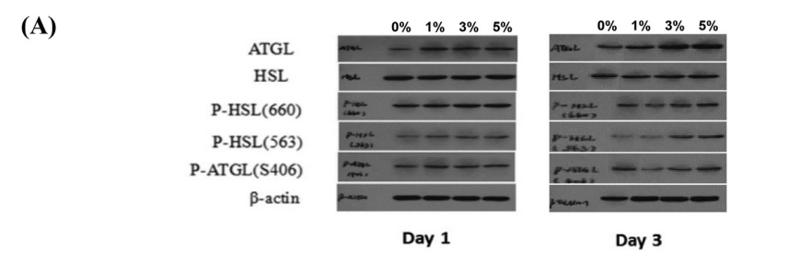
2). Effect of salt promote the muscle triglyceride hydrolysis during dry-salting by inducing the phosphorylation of adipose tissue triglyceride lipase (ATGL) and hormone-sensitive lipase (HSL) and lipid droplets splitting. Food Chemistry, 2020 (PubMed: 32454271) [IF=8.5]

Application: WB    Species: Pig    Sample: adipose

Fig. 3. Western blotting analysis of ATGL, HSL and their phosphorylated protein contents in adipose tissue during processing of dry-cured meat. (A) WB image of each dry-cured group. (B) ATGL relative protein level in adipose tissue. (C) p-ATGL(S406) relative protein level in adipose tissue. (D) HSL relative protein level in adipose tissue. (E) p-HSL(Ser563) relative protein level in adipose tissue. (F) p-HSL(Ser660) relative protein level in adipose tissue.

3). Promotion effect of salt on intramuscular neutral lipid hydrolysis during dry-salting process of porcine (biceps femoris) muscles by inducing phosphorylation of ATGL, HSL and their regulatory proteins of Perilipin1, ABHD5 and G0S2. Food chemistry, 2022 (PubMed: 34815115) [IF=8.5]

4). PLIN1 suppresses glioma progression through regulating lipid metabolism. Cell death & disease, 2025 (PubMed: 39870645) [IF=8.1]

Application: WB    Species: human    Sample:

Fig. 4: PLIN1 suppresses glioma progression through regulating lipid metabolism. A KEGG analysis in the above 33 glioma samples and 15 brain normal samples was shown. B GSEA analysis presented the relationship between glycerophospholipid metabolism and glioma tumorigenesis. C GSEA analysis presented the relationship between fat cell differentiation and glioma tumorigenesis. D Oil red O staining conducted to detect intracellular lipid contents after PLIN1 overexpression in glioma cell lines (Left). Intracellular lipid droplet contents were quantified by ImageJ software (Right). E The intracellular TG levels were detected after PLIN1 overexpression. F The intracellular FFA levels were detected after PLIN1 overexpression. G Lipid metabolism-related genes levels were determined by western blotting. The western blotting bands were quantified with ImageJ software (Right). *P 

5). Fucosylated chondroitin sulfate alleviates diet-induced obesity by modulating intestinal lipid metabolism and colonic microflora. International journal of biological macromolecules, 2024 (PubMed: 39521224) [IF=7.7]

6). MIIP downregulation drives colorectal cancer progression through inducing peri-cancerous adipose tissue browning. Cell & bioscience, 2024 (PubMed: 38245780) [IF=7.5]

7). White adipose tissue, a novel antirheumatic target: Clues from its secretory capability and adipectomy-based therapy. British journal of pharmacology, 2024 (PubMed: 38644540) [IF=6.8]

8). Atractylodin ameliorates obesity-associated hepatic steatosis by regulating the PLIN2-ATGL/CPT1A axis-mediated lipid droplet-mitochondria interactions. Phytomedicine : international journal of phytotherapy and phytopharmacology, 2026 (PubMed: 41936174) [IF=6.7]

9). White-to-brown adipose switching promotes bladder cancer progression. Neoplasia (New York, N.Y.), 2026 (PubMed: 41690005) [IF=6.3]

10). Probiotic Yogurt Alleviates High-Fat Diet-Induced Lipid Accumulation and Insulin Resistance in Mice via the Adiponectin Pathway. JOURNAL OF AGRICULTURAL AND FOOD CHEMISTRY, 2023 (PubMed: 36695046) [IF=5.7]

Load more

Restrictive clause


Affinity Biosciences tests all products strictly. Citations are provided as a resource for additional applications that have not been validated by Affinity Biosciences. Please choose the appropriate format for each application and consult Materials and Methods sections for additional details about the use of any product in these publications.

For Research Use Only.
Not for use in diagnostic or therapeutic procedures. Not for resale. Not for distribution without written consent. Affinity Biosciences will not be held responsible for patent infringement or other violations that may occur with the use of our products. Affinity Biosciences, Affinity Biosciences Logo and all other trademarks are the property of Affinity Biosciences LTD.